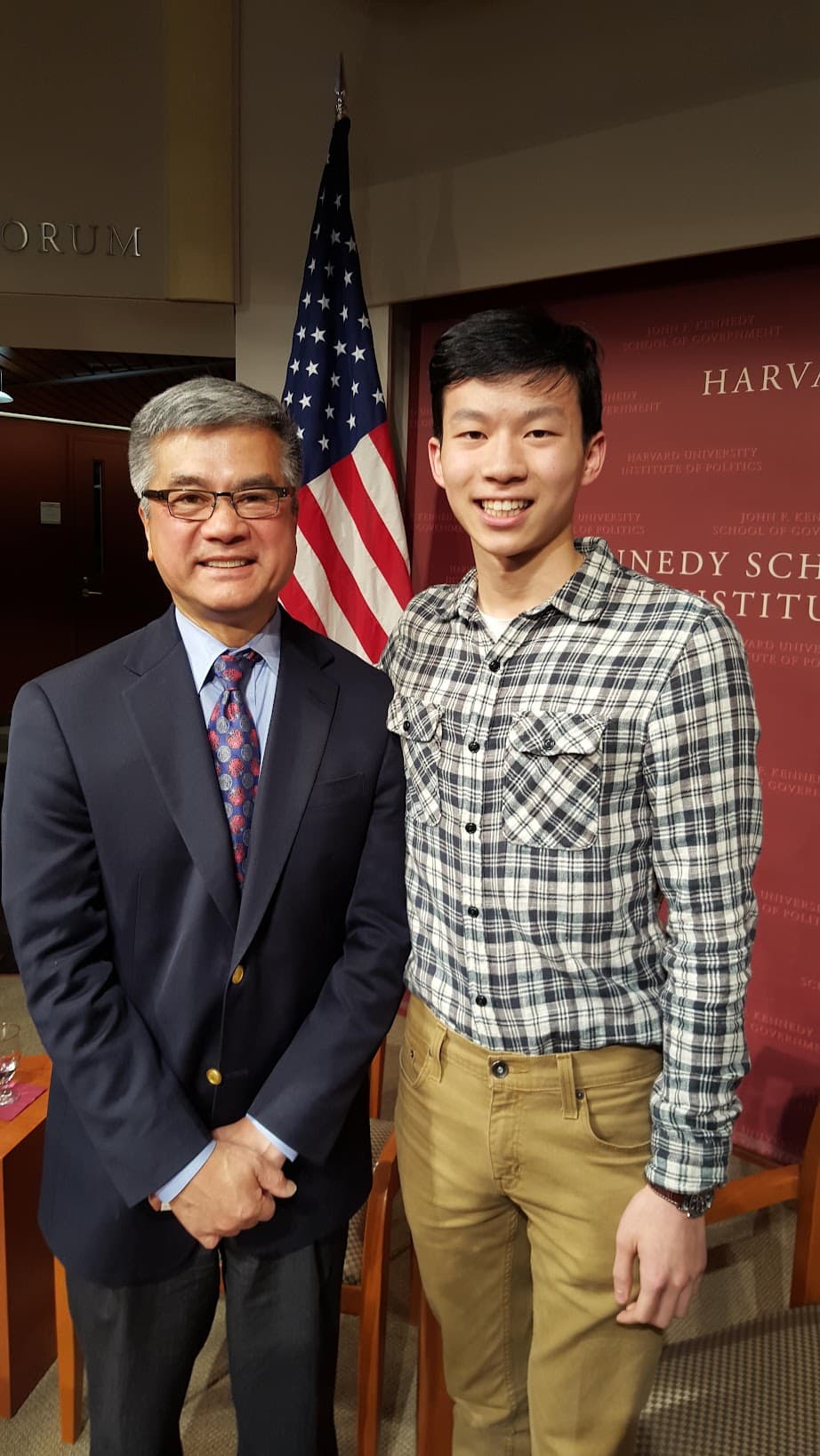
A friend and I were discussing potential career paths. He mused about being an elected official, but questioned if he could even get a lot done in that position.
As one Chinese-American to another, I said to him that even being in that position, you will have great impact because with the current lack of Asian-American prominence, you automatically will be a symbol of hope to Asian-Americans.
This reminds me of Gary Locke and my Grandma. My Grandma, who has been in America for over two decades now, holds a pessimistic view whenever I tell her my wildest dreams and ambitions.
She tells me, "This land [America] is a white man's world, and you with yellow skin can never get ahead", as if to ground my aspirations to reality.
In some sense it is true, and her cynicism did not spontaneously generate. How often does the media perceive Asian-Americans as strong leaders, whether in the political and business spheres or Hollywood and modeling?
So often Asian-Americans with prominence are typecast in a way that is tied to stereotypes. I do not think it is innately wrong to place a role of, say a doctor, if that is a reflection of reality and the culture of hard work and emphasis on education. However, it becomes dangerous when that perception sets limits: when society becomes discouraging on what an Asian-American can achieve, or even worse, when the Asian-American himself does not think he is adequate because of his ethnic background.
I have seen it. I have seen the self-loathing - the wish that he was a different race so he could fit in more. It is so unfortunate, and that can be a detrimental symptom of being a minority in any sense of the word. But here is my resolute response to my Grandma:
"If Gary Locke can do it, it's not a 'white man's world'. And if he, as a Chinese-American, can become governor, I can too!"
Gary Locke is a second-generation American that was elected Governor of Washington State from 1997 to 2005. Though a criticism is that he hasn't done much directly for the Asian-American community. Sure, his policies may not have, but indirectly he has changed Asian-American history forever by changing the hearts of young Asian-Americans across the country, like mine.
I have heard taunts on my Asian physical features all my life. But then to see someone that looks similar to you, and even have the same ancestral land as you (Taishan area in Guangdong), and despite all the odds stacked against him, you see him succeed. You can't help but feel inspired. I see him as a maverick, and even if it was unintentional, that defiance of the norm acts as a beacon of hope to all Asian-Americans.
Now a call to all Asian-Americans: it is up to us to redefine and boldly take pride in what it means to be Asian-American. Yes, by the metric of median income, Asian-Americans have done well in the United States. But monetary success is not sufficient. Identity is multi-faceted and comfort in one's own given skin requires so much more than that. And only if we keep pushing, can we experience progress and hopefully one day eliminate the perceived limits and any self-loathing.
Gary Locke once said: "I'm proud of my Chinese heritage... But I'm thoroughly American." I do not like that conjunction "BUT" and that unfortunately may have been the sentiment of his generation. But times are changing due to his and all the other Asian-American mavericks' efforts, and the definition of what it means to be American and "whose world it is" is also changing. To have a Chinese heritage, or any other heritage for that matter, and to be American are not at odds, but in partnership. I gracefully boast a revised statement: "I'm proud of my Chinese heritage... AND I'm thoroughly American."
Sincerely,
Brian Kalok Lai 黎嘉樂